Showing posts with label history. Show all posts

The grand Willard Hotel DC, some historical surprises

By // No comments:
Most people here in DC know of the Willard: one of the grand dame hotels of the city which one assumes have been there forever.
However what most probably don't know (I for one did not) is that the current hotel is actually mostly a recreation of the historic space!
We recently hosted a tour of the hotel with our ICAA chapter and the hotel historian had some eye opening surprises for us.
Many of the beautiful details which appear to date to the hotel's rebuilding in 1901 when the beaux arts style hotel was built actually date to 1986!
Lets back up here. Yes the hotel is historic. Like many hotels however it has been renovated and rebuilt almost continuously since its founding in 1818 (the year is a stretch but is when a hotel was first built on this site). Above is the lobby as it appeared in 1950. One recognizes the overall space but decoration and mid-centuryisms are the focus.
And above is how the lobby appeared in 1984! This area of Washington suffered greatly during the 1968 riots and after being ransacked the hotel was closed and practically abandoned.
 Finally in 1984 work began under new ownership to rebuild the luxury hotel.
 Above is the famous Peacock Alley, both before and after renovation, where society once had afternoon tea and today you can again as well.
It is said that the term 'lobbyist' was originated in this very hotel. Abraham Lincoln would cross the street from the White house to smoke cigars and have a brandy in the lobby as his wife did not approve of such behavior, and he would be accosted in the lobby by people asking favors; hence the term lobbyist was coined!
 Above the same area before restoration. As many of the fixtures appear to be original and everything in such good 'olde' condition I had assumed the hotel has sat this way for generations.
One of the oldest appearing rooms is known as the Crystal Room which features the original gas (now electrified) chandeliers. The building time period of this hotel was known as the gilded age after all!
 And below the Crystal Room as it appeared prior to the renovation. One can recognize the room by the beautiful plaster ceiling.
 All of the 'marble' pilasters and columns throughout the hotel are faux painted or scagliola (an Italian technique of creating faux marble) done in 1986 (recreating the former faux marble).
 Beautiful crisp plasterwork.
The former grand dining room features mahogany paneling. Sadly the restaurant closed during the recession but is still available for events.
The dining room was the site of a murder by a crazed congressman who shot his waiter in 1856 (read about that here for a good time).
The lower paneling is a recreation of the original as only the upper paneling survived but looks a pretty close match although less ornate.
The hotel also claims to have been where the Mint Julep made its original debut in the famous Round Robin bar(more about that here).  One can still order one in the bar today which I highly recommend!
The restoration of the hotel is a lovely recreation and modernization of this iconic hotel -so successful that no one on the tour had any idea it wasn't all original!
 All is not preserved however. During the renovation the original ballroom on the top floors of the hotel was moved into the basement, seen below, and the upper floors split into additional meeting and guest rooms with a few additional stories added to the hotel.
My favorite part of this renovation however is that the craftsmen still exist to create such intricate detailing.
If you are in the Washington metropolitan area I hope you will considering joining us on one of our many tours or perhaps considering joining the organization! Check out our website's Calendar of events and our facebook page which are constantly updated.
 And if not I hope you will add tea or a drink at the Willard hotel to your Washington visit.
All historic photos provided by the Willard Intercontinental hotel while all present day photos my own.

A visit to the Pantheon in Paris

By // No comments:
Of all of my trips to Paris I had never made it into the Latin Quarter to the Pantheon. Sure, I had admired the neo-classical dome marking the cities' skyline from a distance but never made the trek up the Sainte Genevieve hill to visit until just recently.
 Up close the stunning stone decoration comes into sharp focus.
The huge scale of the interior needs other visitors to fully appreciate.  The proportions are so grand that it's hard to grasp the true scale otherwise.
The building has a fascinating history. Originally built as a church to Saint Genevieve by Louis XV in thanks for surviving an illness, construction began in 1758. The church was designed by architect Jacques-Germain Soufflot who was an early adoptor of the neo-classical style and this was to become his most famous commission.
The history becomes more interesting as the structure was de-consecrated by revolutionists in 1791 and turned into a mausoleum for Great Frenchmen and stripped of all ecclesiastical objects and art.
Later under different governments (France has a rocky history afterall) the Pantheon was to return to use as a church twice until finally becoming a meeting house for French intellectuals with graves in the basement crypt for the most important French intellectuals and scientists.
In 1851 the church was renowned as a hub of science when physicist Leon Foucault demonstrated the rotation of earth with a large pendulum hung from the central dome. This was recently reinstated with a copy seen below as the original is in a nearby museum.
The pantheon may be a temple to intellectuals and science but I was drawn to the great art found within.
 Great sculptures and vast paintings mark moments in French history.
 I particularly liked this painting of Joan of Arc.
 Areas still harken back to the time of when it was used as a church.
 I really admired the jacket of revolutionary war hero Lazare Hoche.
Notice the extra height the doors have visually with the fixed transoms over the operable door (look very carefully for where the operable door ends).  Very elegant overdoors too which also add to the verticality of the space.
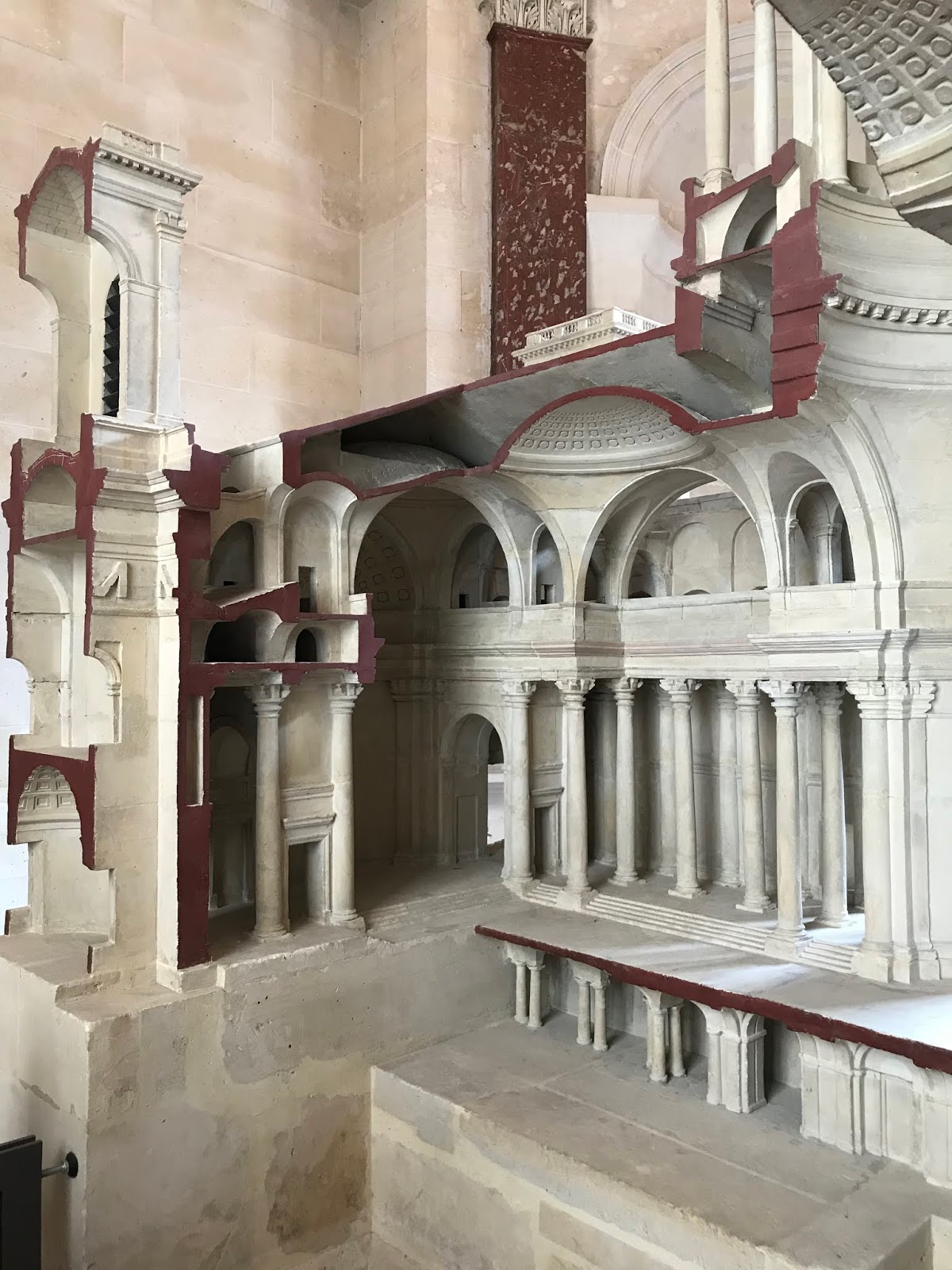
 My favorite item in the Pantheon however has to be the original architectural model!
Built of stone and plaster the model has section cuts painted red which make them clear.  This particularly helps to show the construction of the dome and vaults.
While the appearance of the building is neo-classical,  structurally it utilizes many Gothic methods of construction like cleverly hidden flying buttresses.
 The crypt where many famous French citizens are buried is included in the model.
 While the model is rather rough it still includes details such as this staircase on an upper level.
The large tower shown on the left above no longer survives but you can see the dome of the room in which this model sits underneath.
The main entrance to the crypt is outdoors, seen above, but I really loved the elegant smaller round stairs below enclosed within the building.
 The crypt is enormous with room for centuries of burials.
The first chambers house only a few people such as Rousseau, Voltaire, and the architect of the Pantheon Soufflot.
 Commemorative plaques are found throughout the building.
 Below is the wood coffin of Rousseau in the form of a Greek temple.
 As always, click on the images to view them larger and take in the details.
 Voltaire is marked by this life sized statue.
 Soufflots Greek formed sarcophagus below.
 How cool is this space (literally and figuratively).
 Myriad burial chambers line the entire basement.
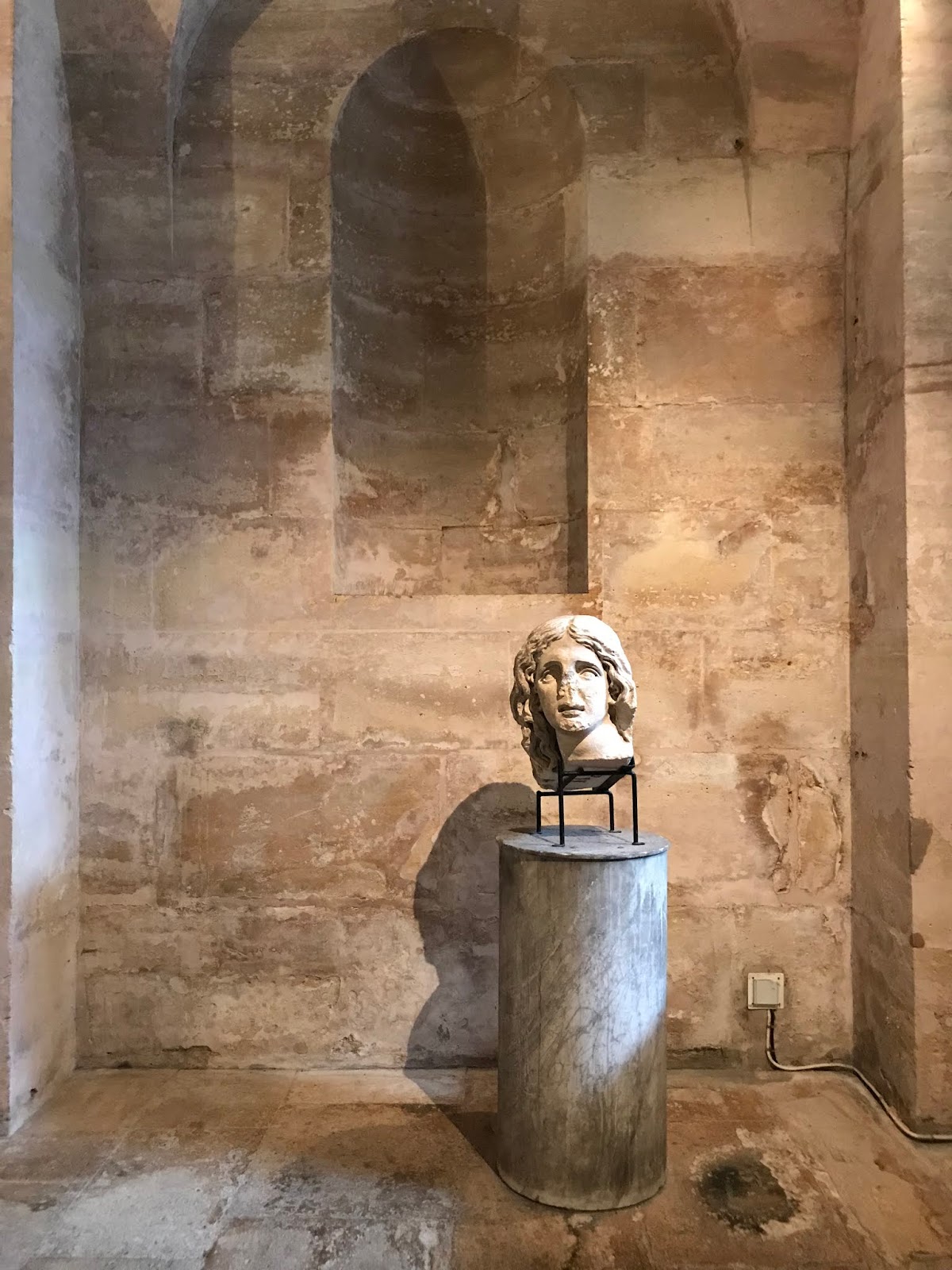
 I loved these pieces of sculpture which had fallen off the pediment artfully displayed in the crypt.
 A long history of the building was also in one of the crypt's chambers.
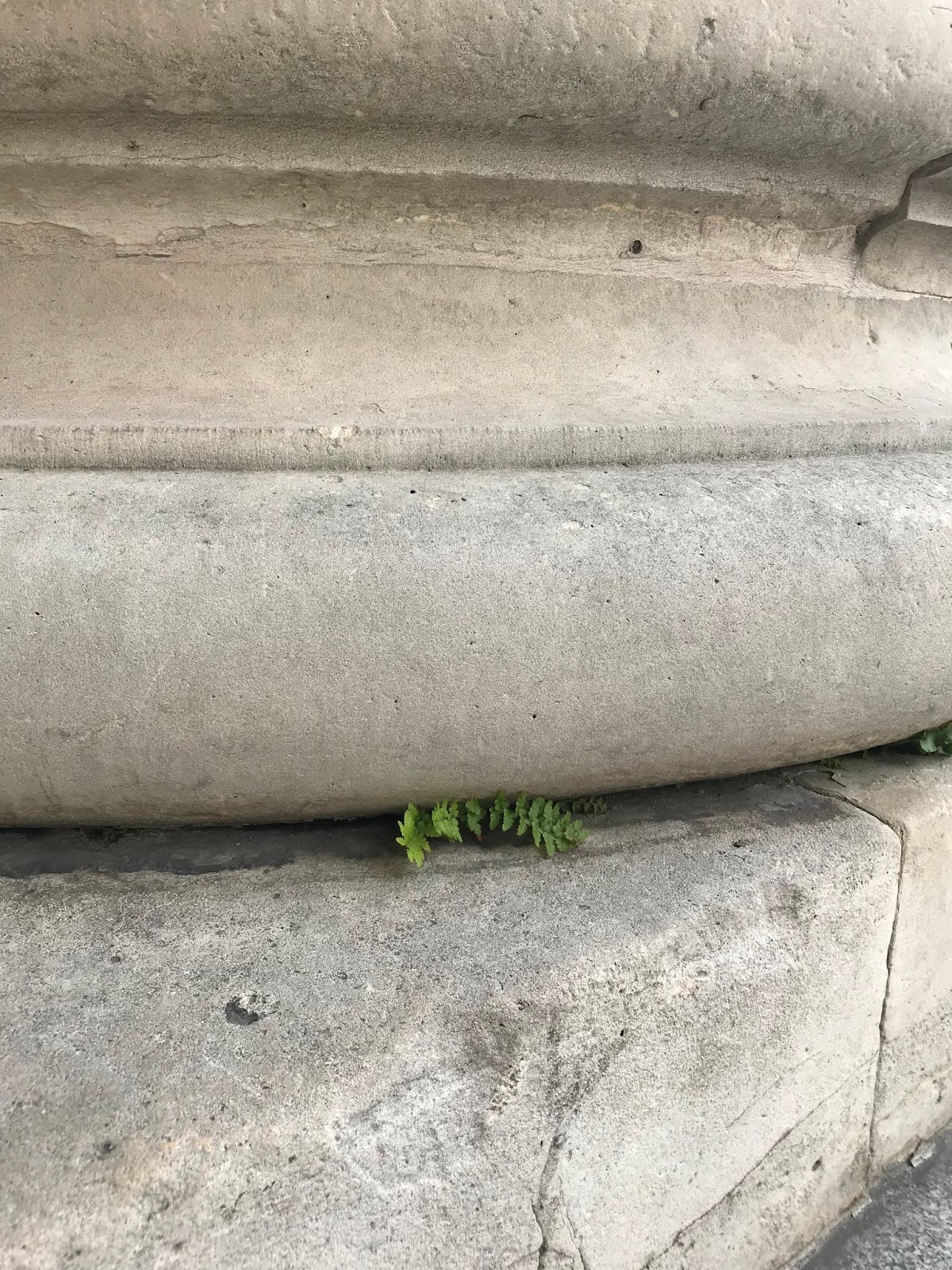
I'm always amazed by nature showing up in the most unexpected spots -here a fern growing under one of the massive stone columns lining the portico.
I'm not sure why I waited through so many years of Parisian getaways to visit the Pantheon. I highly recommend you pay a visit and if you have time, pay the extra 3 euro to visit the roof for a lovely view of the city.

Labels