Of all of my trips to Paris I had never made it into the Latin Quarter to the
Pantheon. Sure, I had admired the neo-classical dome marking the cities' skyline from a distance but never made the trek up the Sainte Genevieve hill to visit until just recently.
Up close the stunning stone decoration comes into sharp focus.
The huge scale of the interior needs other visitors to fully appreciate. The proportions are so grand that it's hard to grasp the true scale otherwise.
The building has a fascinating history. Originally built as a church to Saint Genevieve by Louis XV in thanks for surviving an illness, construction began in 1758. The church was designed by architect
Jacques-Germain Soufflot who was an early adoptor of the neo-classical style and this was to become his most famous commission.
The history becomes more interesting as the structure was de-consecrated by revolutionists in 1791 and turned into a mausoleum for Great Frenchmen and stripped of all ecclesiastical objects and art.
Later under different governments (France has a rocky history afterall) the Pantheon was to return to use as a church twice until finally becoming a meeting house for French intellectuals with graves in the basement crypt for the most important French intellectuals and scientists.
In 1851 the church was renowned as a hub of science when physicist Leon Foucault demonstrated the rotation of earth with a large pendulum hung from the central dome. This was recently reinstated with a copy seen below as the original is in a nearby museum.
The pantheon may be a temple to intellectuals and science but I was drawn to the great art found within.
Great sculptures and vast paintings mark moments in French history.
I particularly liked this painting of Joan of Arc.
Areas still harken back to the time of when it was used as a church.
I really admired the jacket of revolutionary war hero Lazare Hoche.
Notice the extra height the doors have visually with the fixed transoms over the operable door (look very carefully for where the operable door ends). Very elegant overdoors too which also add to the verticality of the space.
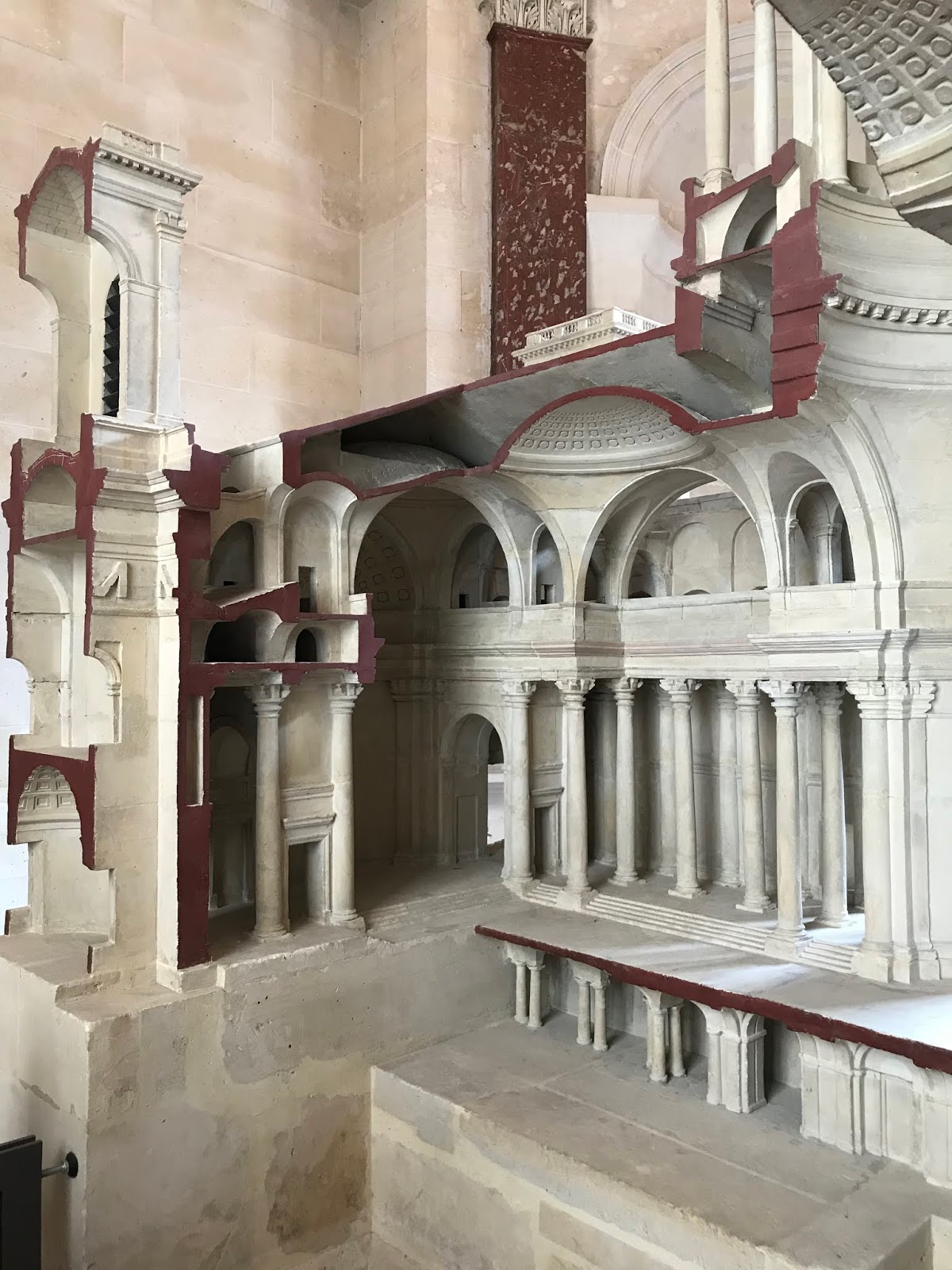
My favorite item in the Pantheon however has to be the original architectural model!
Built of stone and plaster the model has section cuts painted red which make them clear. This particularly helps to show the construction of the dome and vaults.
While the appearance of the building is neo-classical, structurally it utilizes many Gothic methods of construction like cleverly hidden flying buttresses.
The crypt where many famous French citizens are buried is included in the model.
While the model is rather rough it still includes details such as this staircase on an upper level.
The large tower shown on the left above no longer survives but you can see the dome of the room in which this model sits underneath.
The main entrance to the crypt is outdoors, seen above, but I really loved the elegant smaller round stairs below enclosed within the building.
The crypt is enormous with room for centuries of burials.
The first chambers house only a few people such as Rousseau, Voltaire, and the architect of the Pantheon Soufflot.
Commemorative plaques are found throughout the building.
Below is the wood coffin of Rousseau in the form of a Greek temple.
As always, click on the images to view them larger and take in the details.
Voltaire is marked by this life sized statue.
Soufflots Greek formed sarcophagus below.
How cool is this space (literally and figuratively).
Myriad burial chambers line the entire basement.
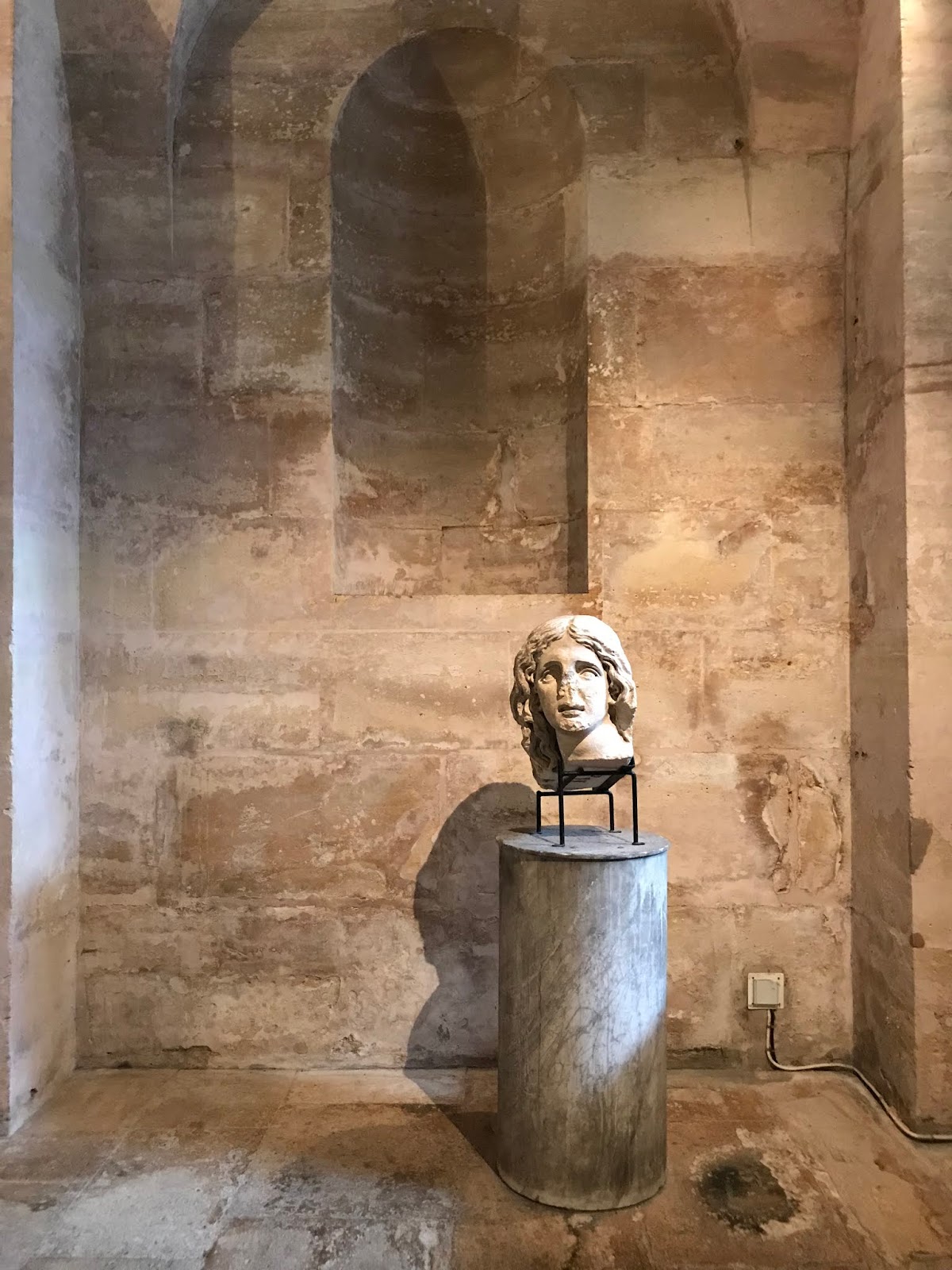
I loved these pieces of sculpture which had fallen off the pediment artfully displayed in the crypt.
A long history of the building was also in one of the crypt's chambers.
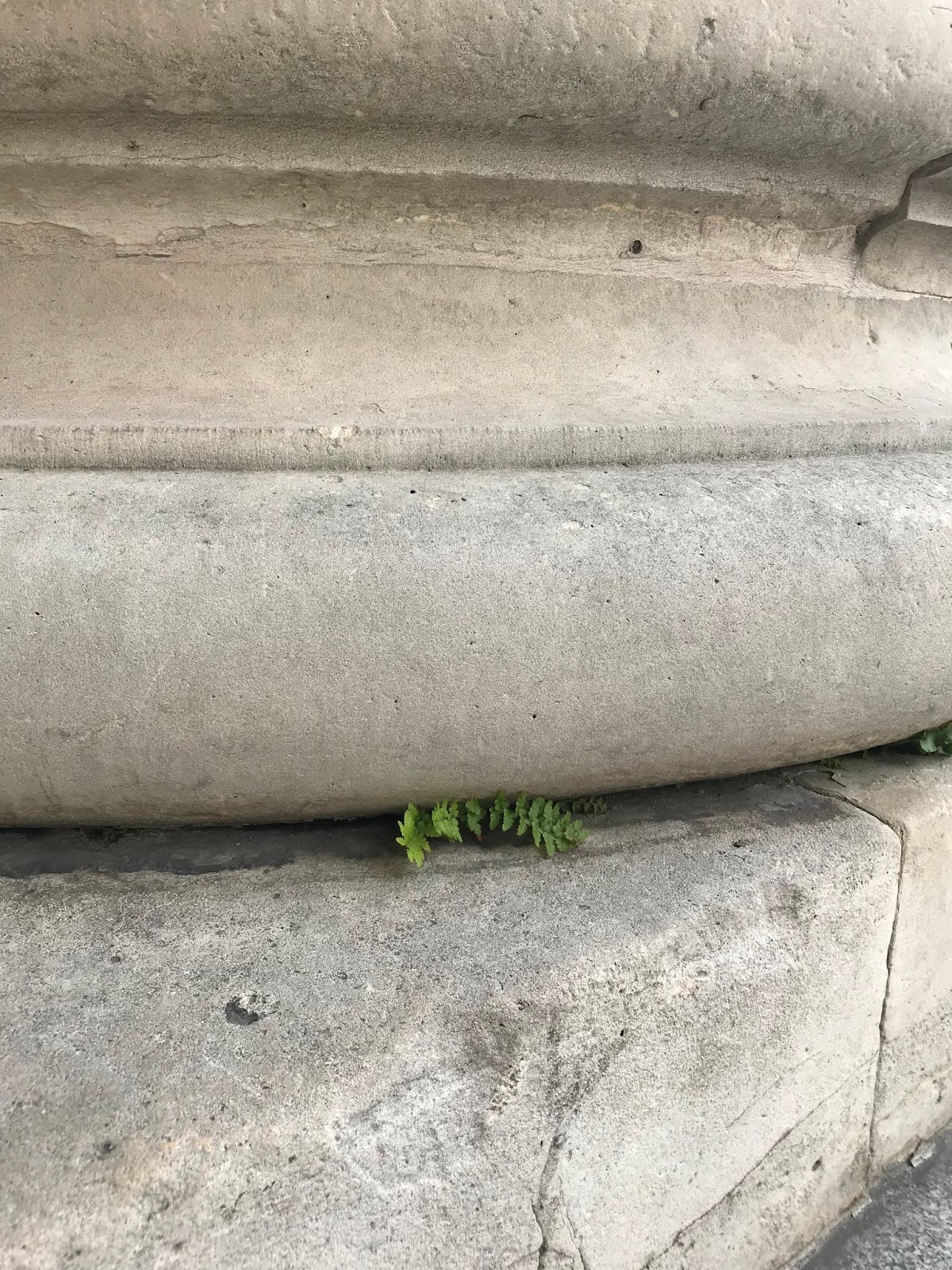
I'm always amazed by nature showing up in the most unexpected spots -here a fern growing under one of the massive stone columns lining the portico.
I'm not sure why I waited through so many years of Parisian getaways to visit the Pantheon. I highly recommend you pay a visit and if you have time, pay the extra 3 euro to visit the roof for a lovely view of the city.